‘They beat me senseless’
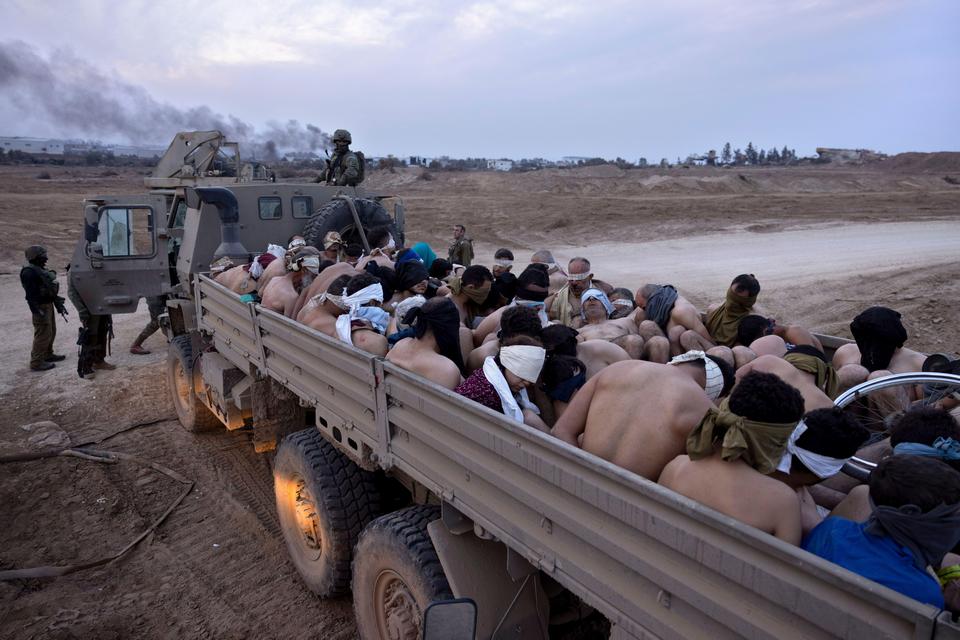
Faoud Hassan, 45-year-old father of five, was dragged from his bed by Israeli troops at two o’clock in the morning. They took him to a jail they called ‘hell’. Israeli forces round up thousands of Palestinians every year and hold them in what an Israeli human rights group calls ‘a network of torture camps’.
There are close to 10,000 Palestinians – mainly men but also women and approximately 350 children – in Israeli prisons, held in shocking conditions, beaten, starved and deprived of medical or legal help. Nearly 3,000 of them are from Gaza. Few are charged and convicted of recognised criminal offences. Most are held as administrative detainees or ’illegal combatants’, without trial, charge or even having committed an offense.
Those who are charged are tried in military not civil courts, applying harsher laws, with conviction rates of 99 per cent.

Hassan is a date picker from the village of Qusra, near the West Bank city of Nablus. He was one of 55 men interviewed for a report by B’Tselem, the Israeli Information Center for Human Rights. The report titled Welcome to Hell – The Israeli Prison System as a Network of Torture Camps reveals abuse as policy.
This is Hassan’s testimony: I woke up, looked through the bedroom window and saw soldiers breaking open the front door. There were more than 15 of them. They handcuffed and blindfolded me, and then one of the soldiers hit me on the back with his gun and pushed me towards the jeep.
There were about 11 soldiers in the jeep, punching, hitting and kicking me with their guns during the ride.
We were transferred to Megiddo prison [in Israel]. As we got off the bus, a soldier said to us: ‘Welcome to hell.’ We were strip-searched again, fully naked. They took us into the Shin Bet [Israel security service] one by one. There was a huge Israeli flag on the wall. He ordered me to kiss it while I was being filmed.
They hit me all over my body with whatever they could find
There were about 20 soldiers in the room. I told the officer I wouldn’t, and he said, ‘You have to kiss the flag.’ I told him ‘No, I don’t want to.’ Suddenly, the 20 soldiers in the room started beating me. They hit me all over my body with whatever they could find. One of them kicked me in the head, and I passed out. They were still beating me when I came around.
They made me stand and took pictures of me with the flag behind me. I was taken out of the room and beaten again until I passed out again. They sat me in the next room, and I kept hearing other detainees being beaten and screaming. All the detainees came out of there bleeding and injured.
The cells had terrible conditions. They were small, we were 12 detainees in a cell that only had four beds. We suffered terribly from the cold. The windows were open, and there were not enough blankets, clothes or pillows. I couldn’t sleep because they would turn on the light all night. The food was terrible and there wasn’t enough of it to live, just not to die. We got no visits, either from lawyers or the Red Crescent [Palestinian Red Cross].
The B’Tselem report says ‘Assaults were a fixture of everyday life in prison, with the use of sprays, stun grenades, metal batons, gun butts, brass knuckles, tasers, and attack dogs – often leading to severe injuries, loss of consciousness, broken bones, and death.’
The testimony of Sami Khalili, 41, from Nablus, who had been serving a prison sentence since 2003 and was held in the Negev Prison, tells of a similarly harrowing experience. ‘We were taken to a room. They forced us to spread our legs and then sit half crouching. Then they started hitting us on our private parts with the metal detector.’ Several testimonies describe sexual abuse, including anal rape, and humiliation of Palestinian detainees by prison guards.


